
China and Pakistan have jointly proposed a five-point peace plan to address the ongoing conflict in West Asia, focusing on de-escalation and safe passage through the Strait of Hormuz.

Trump has made it clear: the US will not lift its blockade of Iranian ports until a deal is signed.

The diplomatic intervention follows various media reports which attributed comments to Iranian lawmaker Alaeddin Boroujerdi, suggesting that merchant vessels were being charged USD 2 million for safe passage through the "conflict-hit Hormuz."

The US government, under President Trump, justifies the intervention as a security necessity rather than a resource grab. The primary official reasons include: narco-terrorism charges, national security and migration crisis.
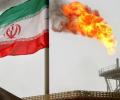
'Indian and Iranian sources both confirmed to me that India and Iran are moving ahead to implement a payment system on buying oil from Iran and hope to finalise it very soon,' says Aveek Sen.

Trump may strike. He may announce productive talks and extend again. He may do both at the same time. Iran will not open the Strait on someone else's terms, so no matter what happens, that problem will remain unsolved. And the IRGC will still be collecting its $2 million toll from every ship bold enough to ask permission to pass.
The US has temporarily permitted India to accept Russian oil already on ships to ensure energy supplies amid the conflict with Iran. This short-term measure is not expected to significantly benefit Russia financially.
The White House has claimed that India has begun 'scaling back' its oil purchases from Russia at the 'request' of President Donald Trump.

The question is whether the clocks allow enough time for two deeply mistrustful sides to get there, and whether the surface calm holds long enough for the paddling to produce something before the ceasefire ends on April 22, notes Prem Panicker in his must read blog on the Iran War.

US President Donald Trump on Monday confirmed that his administration has received a proposal from Iran aimed at ending the ongoing conflict in West Asia, but described the offer as insufficient.

US President Donald Trump threatened to bomb Iran if a deal is not reached before the ceasefire ends, while Pakistan urged both sides to extend the truce and pursue diplomacy.

The intriguing bit is that Trump is likely to attend the talks in Islamabad this weekend -- if he does, it will be the clearest signal yet that the US is ready to exit the war with some sort of win to show, since he cannot afford to go for the talks and return empty-handed, notes Prem Panicker in his must read blog on the Iran War

The ceasefire is still technically holding, to the extent that no overt hostilities have been reported yet, but the rhetoric has hardened dangerously. The week ahead will also clarify whether the Islamabad failure was a negotiating tactic or whether Washington has genuinely locked itself into a position from which the only exits are climb-down, escalation, or the slow bleed of a new status quo that nobody chose and nobody controls. Prem Panicker continues his must read blog on the Iran War.

It is time for India to step up and get Russia, China and Europe to agree to a joint appeal to all combatants. Time is of essence, tomorrow may be too late, asserts Colonel Anil A Athale, former head of the history division, ministry of defence.

Indian OMCs have not been buying Iranian or Venezuelan crude which is actually sanctioned by US. OMCs have always complied with the price cap of $60 for Russian oil recommended by the US.

The delegations from the US and Iran head to Islamabad on Friday, carrying a ceasefire that is already fraying, a Strait that is technically open and practically closed, and a negotiating agenda that would challenge even parties actually negotiating in good faith, which these groups are not. Prem Panicker continues his must read blog on the Iran War.

India, the world's third-largest oil consumer, spent 2.5 billion euro on buying crude oil from Russia in September, 14 per cent less than the previous month, a European think tank said. India remained the second-largest buyer of Russian fossil fuels in September behind China, according to the Centre for Research on Energy and Clean Air (CREA).

Egypt, Pakistan, Saudi Arabia and Turkey met in Islamabad in what analysts say is the formal opening of a new diplomatic formation that could reshape the post-war regional order. Their immediate goal is a ceasefire; their larger ambition is to ensure that neither Iran nor Israel emerges from this war in a dominant position. Pakistan's foreign minister then flew directly to Beijing and mooted a Chinese role as guarantor of any eventual agreement. Prem Panicker continues his must read daily blog on the Gulf War.

The US President clarified that these negotiations do not involve the new Supreme Leader, Mojtaba Khamenei.

'What we have yet to see on either the US or the Iranian side is willingness to compromise on their ultimate demands and the flexibility to reach an agreement to end the war.

'Our diplomacy should have been focused on preventing war and avoiding the inevitable disruptions it would cause, posing a real risk to India's growth story,' asserts former foreign secretary Shyam Saran.

The urgency for a resolution is underscored by the military situation, as joint operations by Israel and the US have consistently been "targeting Iran's missile systems, launch sites and other critical infrastructure" since the onset of the conflict.

It may now be time to question the price India is paying for Israel's disregard of the serious undermining of India's energy security, asserts former foreign secretary Shyam Saran.
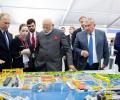
India is preoccupied with analysing the US sanctions, which may cut off India's access to discounted Russian crude and force it to buy at market prices.
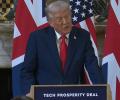
During a visit to the UK, former US President Donald Trump reiterated his claim of intervening to resolve a conflict between India and Pakistan, linking it to trade negotiations. He also discussed tariffs on India for buying Russian oil and the Russia-Ukraine conflict.

India has stated it will wait for the outcome of the elections in Bangladesh and the resulting mandate before addressing any existing issues. The country also affirmed its support for free, fair, inclusive, and credible elections in Bangladesh.

When missiles fly in this region, they are never just aimed at military targets.

Saudi Arabia and the UAE are actively pushing Trump to take the war to its bitter finish and 'erase' Iran's presence in the geopolitics of the region. Simply put, the two most powerful Sunni Arab oligarchies are on the same page as Israel. Such interference increases the risk of a breakdown in dialogue between the US and Iran, points out Ambassador M K Bhadrakumar.

US Treasury Secretary Scott Bessent indicated a potential pathway to remove tariffs imposed on India for purchasing Russian oil, citing a significant decrease in such purchases. He also criticized Europe's approach and accused India of profiting from discounted Russian oil.

The purge in Washington does not pause the war. Strikes continue, Hormuz remains closed, and Brent crude is still dancing around $109 a barrel. For India, the command chaos in the Pentagon is another layer of uncertainty piled on five weeks of conflict that was already straining every buffer Delhi has.

Fight on toward goals that keep receding, or exit with most objectives unmet. Trump is agitated, his poll numbers falling below the Plimsoll line, his base fractured between those who back the war and those who remember that he campaigned on ending them.

'Was the five-day pause ever meant to hold, or was it simply another instrument of signaling, of positioning, of buying time in a war where even the pauses are tactical?' asks Prem Panicker in his must read daily blog on the Gulf War.

US Treasury Secretary Scott Bessent's remarks come ahead of a high-level summit where India and the European Union are expected to formally announce the conclusion of negotiations on a comprehensive free trade agreement.
Two days after Russian President Vladimir Putin concluded his visit to India, during which he assured that Moscow would remain a reliable energy supplier, the Kremlin on Monday said that India, as a sovereign nation, is free to buy oil from sources it deems beneficial. It expressed confidence that New Delhi will continue to prioritise its economic interests.
Russia has a "special mechanism" to confront any challenge arising out of the US slapping punitive measures against India for its procurement of Russian crude oil, Russian charge d'affaires Roman Babushkin said on Wednesday.
The wide-ranging sanctions imposed by the US on the Russian oil sector have started to dent near-term oil flows to India with state-owned Bharat Petroleum Corporation Ltd (BPCL) saying not enough cargoes are available for March.

The United States, which entered this war in expectation of a short, sharp win along the Venezuela model, is now preparing for deeper involvement in a conflict it does not fully control, without the allies it typically relies on, against an adversary that is not behaving as expected, in a global environment that is already absorbing economic shock. Prem Panicker continues his must read daily blog on the Gulf War.
United States President Donald Trump has said India is 'very close' to China in terms of its purchases of Russian oil and will pay tariffs of 50 per cent as he indicated that 'you are going to see so much secondary sanctions'.

Taking Kharg would give the US control over virtually all of Iran's oil exports and thus provide significant leverage, notes Prem Panicker in his must read daily blog on the Gulf War. It would also put American troops within range of Iran's remaining missiles, drones, and artillery on a piece of real estate that is just eight square miles in size, and just 15 miles from the Iranian mainland.

The LPG squeeze on India's restaurant sector is the quotidian face of a deeper crisis.
